

HYUNSOO KIM, Sang Ryong Jeon et al.
[Phase 1 Study on Spinal Cord Injury] Safety and Changes in Motor Function Following Administration of Autologous Bone Marrow-Derived Mesenchymal Stem Cells in Patients with Spinal Cord Injury
Research Summary
Ten patients with traumatic cervical spinal cord injuries were treated with mesenchymal stem cells cultured from their own bone marrow. Six of the 10 patients experienced improved arm strength, and three showed improvements in activities of daily living; no serious complications were reported. However, there was no change in the ASIA score, which indicates the degree of paralysis, and this is a preliminary study involving 10 patients with no control group.
Study Results
Ten patients who had suffered spinal cord injuries in the cervical region due to trauma, resulting in paralysis of their limbs, participated in the study. The research team administered mesenchymal stem cells, cultured from the patients’ own bone marrow, to both the site of the injury and the spinal canal. Evaluations were conducted before surgery and at 3 and 6 months post-surgery.
The ASIA grade remained unchanged in all patients. Arm muscle strength improved in 6 out of 10 patients. Of these, 3 were able to prepare meals while wearing a brace, sit without assistance, and hold a glass of water on their own. Changes were observed in 6 patients on electrophysiological testing and in 7 patients on MRI.
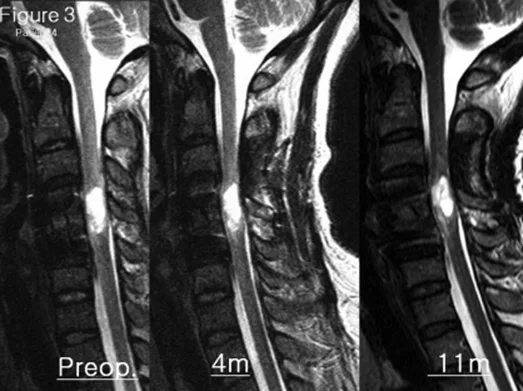
None of the 10 patients experienced any serious complications or adverse reactions. One patient reported a tingling sensation in the trunk and legs for 10 months, but this resolved spontaneously. There were no cases of infection, neurological deterioration, or immune reactions. Follow-up MRI scans showed no signs of syringomyelia (fluid accumulation within the spinal cord) or cellular hyperplasia.
Study Design
This study is a preliminary clinical trial with a control group, randomization, and no blinding. It was conducted at one tertiary general hospital in Korea. Ten patients who had sustained traumatic cervical spinal cord injury one month prior were enrolled. All patients had complete motor paralysis and no muscle atrophy or psychiatric issues. Participants were aged 34 to 61 years; four were classified as ASIA Grade A and six as ASIA Grade B. The duration since injury ranged from 1 month to 108 months.
Outcome measures included the ASIA motor score, electromyography (EMG) and nerve conduction velocity (NCV), sensory and motor evoked potentials (MEPs), and contrast-enhanced MRI. The follow-up period was 6 months for 8 participants, 10 months for 1 participant, and 11 months for 1 participant.
Cells Used and Administration Method
The cells used were autologous bone marrow-derived mesenchymal stem cells obtained from the patients’ own bone marrow. Bone marrow was harvested from the iliac crest and cultured in a GMP facility for 4 weeks up to the fifth passage. The release criteria were a viability rate of 90% or higher, negative for microbial contamination, and at least 90% of cells positive for CD73 and CD105.
The research team administered the cells in three separate doses. During the first surgery, the researchers opened the bone and dura mater at the back of the spine and injected 8 × 10⁶ cells into the damaged spinal cord. They then divided 4 × 10⁷ cells and injected them into the subarachnoid space. Four and eight weeks later, they administered two additional doses of 5 × 10⁷ cells each via lumbar puncture.
Discussion
This study tested a method of directly injecting autologous bone marrow-derived mesenchymal stem cells into the injured spinal cord. Previous literature has reported that motor function recovery plateaus 12 months after injury. In this study, 3 of the 6 patients treated 12 months after injury showed improved muscle strength. The researchers explained that this difference may be due to the effects of the cell therapy.
On MRI, the thickened areas of the spinal cord did not show contrast enhancement. The researchers noted that this finding may be related to axonal regeneration rather than a tumor or inflammation.
There are also clear limitations. As this was a preliminary trial involving 10 participants without randomization or a control group, statistical significance could not be confirmed. Since previous reports on cell dosage were inconsistent, the most commonly used dose was selected. The observation period lasted only 6 to 11 months. Cell culture and manufacturing were conducted at Pamcell’s GMP facility.


