

Acute Respiratory Distress Syndrome Caused by COVID-19
- Patient
- A 73-year-old man
- Diagnosis
- Acute Respiratory Distress Syndrome Caused by COVID-19 (Confirmed in 2020; developed on the 5th day of hospitalization)
- Treatment
- A single intravenous infusion of autologous bone marrow-derived mesenchymal stem cells (9×10⁷ cells)
- Observation
- 110 days after administration (at the time of discharge)
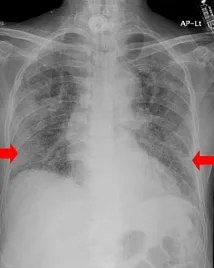
Before

Viewable after sign-in in accordance with medical advertising regulations.
Sign in to viewAfter
| Point of View | Treatment and Intervention | Observed Changes |
|---|---|---|
| Before Treatment (28th Day of Hospitalization) | Tracheotomy | On mechanical ventilation, PaO₂/FiO₂ 134.4 mmHg |
| On the day of administration | Intravenous Administration of Mesenchymal Stem Cells | PaO₂/FiO₂ 137.4 mmHg · Oxygen saturation 93.2% |
| Day 3 of treatment | Bilateral ground-glass opacities and a cavity in the right upper lobe on chest CT; oxygen saturation 87.3% | |
| Day 5 of treatment | Add aspirin | Confirmation of a cerebral infarction in the anterior cerebral artery territory accompanied by nystagmus |
| Day 7 of treatment | Decreased opacity in both lower lung fields on a chest X-ray | |
| Day 14 of treatment | PaO₂/FiO₂ 249.5 mmHg · Oxygen saturation 97.7% | |
| Day 25 of treatment | Weaning from a ventilator | |
| Day 28 of treatment | High-Flow Nasal Oxygen Therapy | PaO₂/FiO₂ 279.4 mmHg · Oxygen saturation 98.2% |
| Day 110 of administration | Discharged after respiratory rehabilitation; died one month after discharge due to acute kidney injury |
Overview
The patient presented to the hospital in March 2020 with fever and fatigue, tested positive for COVID-19, and developed acute respiratory distress syndrome on the fifth day of hospitalization. Despite treatment with chloroquine, lopinavir/ritonavir, antibiotics, and intravenous steroids, the patient showed no improvement and underwent tracheostomy on the 28th day of hospitalization. In this case, a single intravenous infusion of 9×10⁷ (90 million) allogeneic mesenchymal stem cells cultured from the bone marrow of a healthy donor was administered. Conventional treatments, such as mechanical ventilation, were continued as before.
Progress
No initial adverse reactions, such as allergic reactions, were observed following administration. On day 7, a chest X-ray showed a reduction in bilateral lower lung field opacities, and on day 14, the PaO₂/FiO₂ ratio (an oxygenation index) rose to 249.5 mmHg. On day 25, the patient was weaned off the ventilator, and on day 106, a CT scan showed no cavity in the right upper lobe. However, seizures and a cerebral infarction were confirmed on day 5 after administration; the authors noted that, given the combination of various treatments, it could not be conclusively determined that these improvements were due solely to the stem cell therapy. The patient was discharged on day 110 after administration but died one month later from acute kidney injury.
Source Kim K, Bae KS, Kim HS, Lee WY. Effectiveness of Mesenchymal Stem Cell Therapy for COVID-19-Induced ARDS Patients: A Case Report. Medicina. 2022;58(12):1698. (CC BY 4.0)
This is an anonymised record of an individual case. Outcomes vary from person to person, and every medical procedure carries the possibility of side effects.
This case does not guarantee any treatment outcome. Stem cell treatment is carried out only within approved clinical research and licensed indications for each condition.


